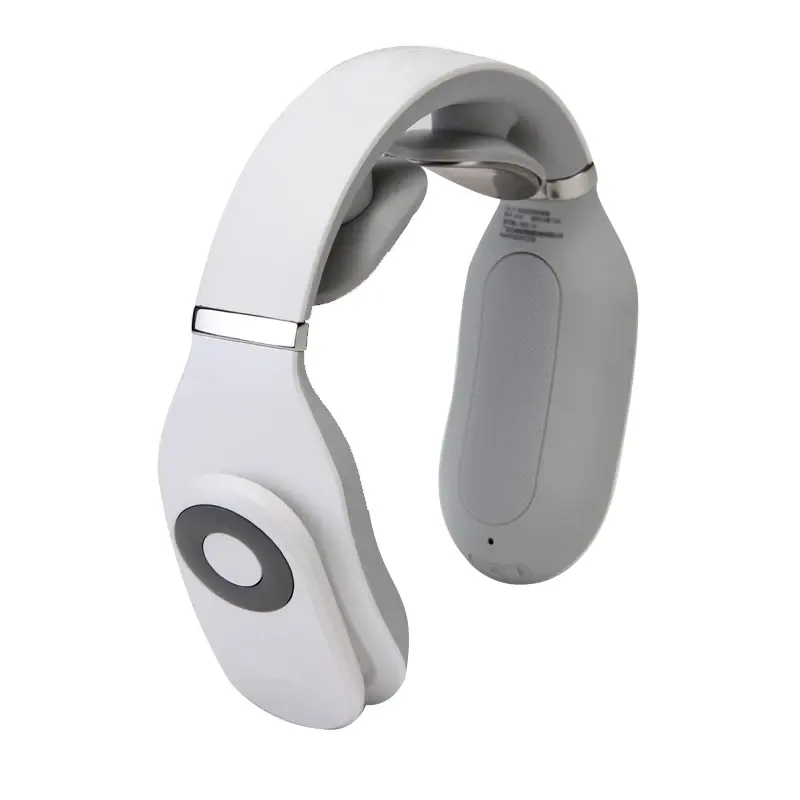
Why format matters more than features
Neck and shoulder massagers are sold on feature lists — node counts, heat settings, speed levels. In practice, the thing that determines whether a device gets used is far simpler: does its shape suit where and how you intend to use it?
A device that needs both hands is useless at a desk. One that requires sitting back against a chair will not work on a flight. A wearable unit that looks ideal for computer work may apply pressure in the wrong place for your build.
An important safety boundary first
Before format, one rule applies to every device in this category. The front and sides of the neck are not appropriate treatment areas. Stiftung Warentest's guidance for percussive devices states that blood vessels and nerve pathways must not be treated, and major vessels run close to the surface there.
Slavko Rogan of Bern University of Applied Sciences describes the appropriate targets as large muscle groups, including the shoulder region with the upper and forearms — the muscular shoulder and upper back area, not the throat or the sides of the neck.
Devices designed for this area generally position their contact points on the trapezius and upper back musculature for exactly this reason. If a device applies pressure to the front or sides of your neck, that is a design problem.
The main formats compared
| Format | How it is used | Hands free? | Best setting |
|---|---|---|---|
| Wearable / open-neck | Rests on shoulders, worn | Mostly | Desk, standing, moving around |
| Shiatsu wrap with straps | Pull straps to control pressure | No | Seated, at home |
| U-shaped | Sits over shoulders, control unit integrated | Partly | Desk, sofa |
| Wraparound padded | Larger coverage, upper body | No | Home, relaxed sitting |
| Massage pillow | Placed between body and chair | Yes | Chair, car seat, sofa |
| Seat cushion (full back) | Covers whole back | Yes | Office chair, car |
| Handheld percussive | Directed by hand | No | Spot treatment, varied areas |
Matching format to use case
- Desk work during the day: a wearable or U-shaped unit, because you can keep typing. A pillow between your back and the chair also works.
- Relaxing at home: a shiatsu wrap with pull straps gives direct pressure control, which matters because the right pressure differs between people.
- Driving: a seat cushion or massage pillow with a vehicle power option, rated for in-car use rather than adapted with a generic adapter.
- Frequent travel: a compact pillow or mini percussive device. Full wrap formats are bulky.
- One device for several body areas: handheld percussive is the only genuinely multi-area format, but it needs a free hand and conscious technique.
- Limited shoulder mobility: a pillow or seat cushion, since you position your body rather than reaching.
Shiatsu vs percussion for this area
Shiatsu-style uses rotating nodes that knead in a circular motion, applying sustained, broader pressure. Percussive strikes rapidly at a fixed amplitude, and the 2023 systematic review describes floating the device over the skin in short bursts.
For the neck and shoulder region specifically, the kneading approach is more common in fixed-position devices, for a practical reason: a device resting on your shoulders cannot be floated over the muscle the way a handheld percussive device is meant to be. Kneading nodes work with sustained contact; percussion is designed for movement across the muscle.
Evidence does not clearly favour either. The review found percussive therapy produced acute increases in flexibility and reduced reported pain over multiple sessions, while noting all studies had methodological limitations.
Heat — useful or marketing?
Many devices in this category add heat, and some percussive devices now offer heated or cooled attachments. Heat is a long-standing comfort measure for muscle tension and is generally pleasant. What it is not is a therapeutic claim — a heated device is not treating a condition.
Two practical points: heat adds battery drain, so check whether the stated runtime includes heating; and if you have reduced sensation in the area, such as from diabetic neuropathy, discuss heated devices with a clinician first.
What to check before buying
- Contact point position — pressure should fall on the muscular shoulder and upper back, not the front or sides of the neck
- Pressure adjustability — strap-based designs give you direct control; fixed ones do not
- Power source — mains, USB or vehicle, matching where you will use it
- Fit to your build — fixed node spacing suits some body types better than others
- Noise, a recurring complaint across massage devices
- Material documentation — ask for PAH test reports on skin-contact parts
- Auto shut-off, a standard safety feature worth confirming
Frequently asked questions
Can I use a neck massager on the front of my neck?
No. Major blood vessels and nerves run close to the surface there. Devices should contact the muscular shoulder and upper back area only.
Which is better for desk work, wearable or pillow?
Wearable if you need to move around; pillow if you stay seated in a supportive chair. The pillow requires nothing of your hands.
Is shiatsu better than percussion for neck tension?
Neither is clinically proven superior. Kneading suits fixed-position devices because they maintain contact; percussion is designed to be moved across the muscle.
How long should a session last?
Most devices in this category include auto shut-off, commonly around 15 minutes, which is a reasonable guide. Stop earlier if there is any discomfort.
Will a massager fix my neck pain?
It may help with minor muscle aches and tension. Persistent neck pain, or pain with numbness, weakness or headaches, needs proper assessment.
Sources
- Stiftung Warentest — Massagepistolen im Test — 24 June 2024
- SRF Kassensturz — massage gun test incl. Rogan interview — 8 October 2024
- Sams L et al., Int J Sports Phys Ther (PMID 37020441) — 1 April 2023
This article is general information, not medical advice. A therapeutic massager is intended to relieve minor muscle aches and pains; it does not diagnose, treat, cure or prevent any disease. Consult a qualified healthcare professional about your individual circumstances.