The short answer
A foam roller is cheaper, has no battery to fail, and covers large areas using your body weight. A massage gun is portable, targets specific muscle bellies precisely, and requires no floor space.
Neither is clinically proven better than the other. Anyone claiming otherwise is selling something. The more useful question is which fits your body, your routine and your budget.
What each one actually does
Foam roller: you position your body over the roller and use your own weight to apply pressure, moving slowly along the muscle. Pressure is broad and controlled by how much weight you shift onto it. No power source, essentially nothing to break.
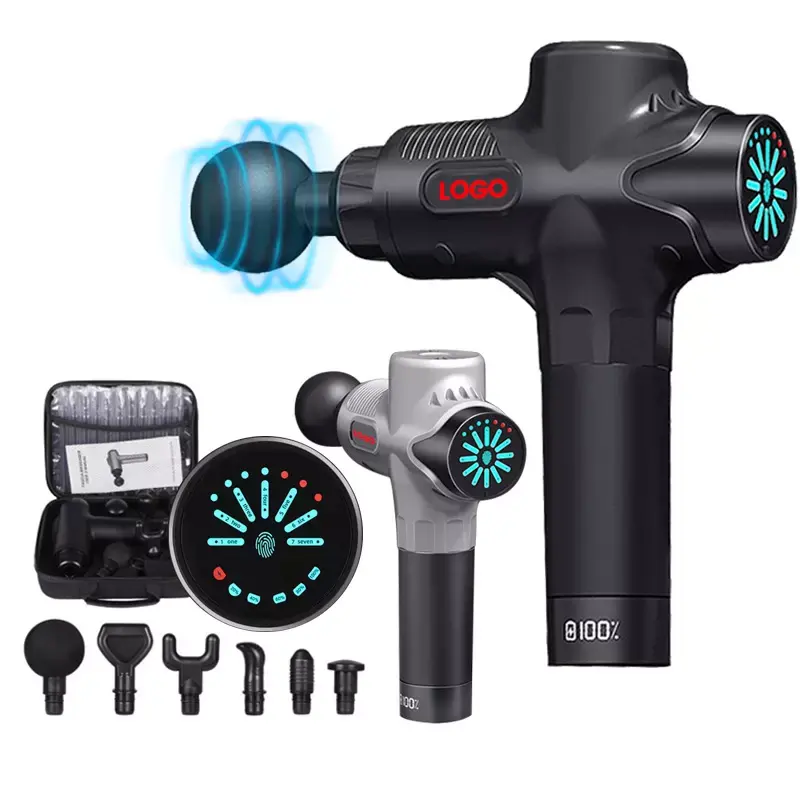
Massage gun: a motorised head strikes the muscle rapidly. Each device has a fixed amplitude — how far the head travels per stroke — which you cannot adjust. You only control frequency. This matters more than most product pages admit, and it is why two devices with identical advertised speeds can feel completely different.
Head-to-head
| Foam roller | Massage gun | |
|---|---|---|
| Typical price | Low | Low to high (EUR 40-298 in the 2024 test sample) |
| Power needed | None | Rechargeable battery |
| Portability | Bulky but light | Fits a gym bag |
| Precision | Broad areas | Specific muscle bellies |
| Hard-to-reach areas | Difficult | Easier |
| Pressure control | Your body weight | Device setting plus how you hold it |
| Requires floor space | Yes | No |
| Noise | Silent | A recurring complaint |
| Failure mode | Essentially none | Battery dies, device often unusable |
| Suits limited mobility | Poorly — requires getting down and up | Well — use seated or standing |
What the research supports
The strongest synthesis available is Sams et al. (April 2023), covering thirteen studies on percussive therapy. It found a significant relationship between a single application and acute increases in muscle strength, explosive strength and flexibility, with multiple treatments reducing reported musculoskeletal pain.
Two caveats the authors state themselves: all studies had limitations in methodological quality or reporting; and only one of the thirteen looked at effects 24 and 48 hours later. The rest measured acute, short-term effects only.
Foam rolling appears in that same literature as a comparator — several studies used it as the control against which percussive therapy was measured. It is an established method, not a lesser one.
Conclusion from the evidence: both produce short-term mobility improvements. Neither has strong evidence for long-term change. Choose on practicality.
The uncomfortable finding from independent testing
If you are leaning toward a massage gun, this is the part worth reading twice. Stiftung Warentest tested eleven massage guns in June 2024, from EUR 40 discount models to EUR 298 premium devices. Not one achieved an overall "good" rating.
| Brand | Model | Price (CHF) | Score /100 |
|---|---|---|---|
| Blackroll | Fascia Gun | 129 | 63 |
| Medisana | MG 600 | 105 | 62 |
| Beurer | MG 99 | 60.90 | 58 |
| Flow Recovery | Flow Move | 139 | 23 |
| Hyperice | Hypervolt 2 | 199 | 20 |
Why those scores were so low
Harmful substances. Testers found very high levels of naphthalene in the plastic of the Hyperice Hypervolt 2 and the Flow Recovery Flow Move — well above what Germany's GS safety mark permits. Naphthalene is a polycyclic aromatic hydrocarbon; per the Swiss Federal Office for the Environment there is suspicion of carcinogenic effect. Both devices were downgraded to poor despite scoring satisfactory or good on massage performance.
Non-replaceable batteries. Batteries are permanently installed. When the battery fails, the whole device becomes waste even though it would otherwise still work. SRF called it a major annoyance, and it was a key reason no device scored well.
The Austrian consumer organisation KONSUMENT, which ran the joint test, headlined its report "Keine Wunderdinger" — no miracle workers. Worth noting: the cheapest device in that table outscored the most expensive by a wide margin. Price was not a reliable guide to safety.
A foam roller has none of these failure modes.
Which to choose by situation
- Choose a foam roller if you are on a tight budget, want something that will not fail, work on large areas like the back and IT band, or dislike noise.
- Choose a massage gun if you travel, need to reach specific muscle points, find getting down to the floor difficult, or want to treat shoulders and arms where body weight is awkward.
- Buy a massage gun with extra care if you are sensitive to pressure or bruise easily, since testers found some devices strong enough to cause haematomas.
The case for both
They are complementary, not mutually exclusive. A common split: foam roller for large-area work before or after training — quads, hamstrings, back, IT band. Massage gun for specific spots the roller cannot reach well, and for travel. Since a basic foam roller costs little, owning both is realistic for most budgets.
Frequently asked questions
Is a massage gun worth it for back pain?
It may help relieve minor muscle aches, but keep the device on the muscle either side of the spine, never directly on the spine. For back pain that persists, is severe, or comes with numbness or weakness, see a clinician.
Which is better for sore muscles after a workout?
The evidence does not clearly separate them. Sams et al. found multiple percussive treatments reduced reported musculoskeletal pain, while conventional massage already had support for improving delayed onset soreness.
Are expensive massage guns better?
Not according to the 2024 testing. The CHF 199 Hypervolt 2 scored 20/100 while the CHF 60.90 Beurer MG 99 scored 58/100 — because of harmful substances in the plastic, not massage performance.
Do massage guns break down lactic acid or scar tissue?
There is no good evidence for either claim, and lactic acid clears on its own within roughly an hour. What the research supports is short-term flexibility and strength changes, and reduced perceived soreness with repeated use.
How do I know if a massage gun is materially safe?
Ask the manufacturer for test documentation on polycyclic aromatic hydrocarbons for every component that contacts skin — housing, grip, control panel and attachments separately.
Sources
- Stiftung Warentest — Massagepistolen im Test — 24 June 2024
- SRF Kassensturz — massage gun test — 8 October 2024
- KONSUMENT (VKI) — Massagepistolen Test 2024 — 25 July 2024
- Sams L et al., Int J Sports Phys Ther (PMID 37020441) — 1 April 2023
This article is general information, not medical advice. A therapeutic massager is intended to relieve minor muscle aches and pains; it does not diagnose, treat, cure or prevent any disease. Consult a qualified healthcare professional about your individual circumstances.