Why the headline number misleads
Most massage guns are sold on one number: percussions per minute, usually something like up to 3,200 PPM. On its own that figure tells you very little. A device striking 3,200 times a minute with a 10 mm stroke delivers a completely different sensation to one striking at the same rate with a 16 mm stroke.
The 2023 systematic review in the International Journal of Sports Physical Therapy names the three specifications directly: percussive therapy is comprised of a triad of characteristics — frequency (Hz), amplitude (mm) and torque (lbs).
PPM is simply frequency expressed per minute instead of per second. It is one leg of the triad, presented as though it were the whole thing.
The three specs that matter
| Spec | Unit | What it controls | Adjustable? |
|---|---|---|---|
| Amplitude | mm | How deep each stroke travels | No — fixed in hardware |
| Frequency | Hz (or PPM) | How many strokes per second | Yes, via settings |
| Stall force | N or lbs | Pressure before the head stops | No |
Amplitude — the one you cannot change
Amplitude is the distance the head travels on each stroke. Stiftung Warentest puts it plainly: every massage gun has a fixed amplitude with which its attachments rise and fall.
This is the single most consequential spec, because it is the one you are permanently stuck with. Frequency you can dial down. Amplitude is built into the mechanism.
A 16 mm stroke reaches noticeably deeper than a 10 mm stroke at the same frequency. Neither is universally better — deeper is not automatically more useful, and Warentest's testers experienced some devices as too strong, noting that haematomas could then occur. If you are sensitive to pressure or bruise easily, a lower amplitude is the safer choice.
| Device used in reviewed studies | Amplitude |
|---|---|
| Theragun | 16 mm |
| Hypervolt | 10-12 mm |
| Yunmai | 10 mm |
Frequency and the 30-per-second threshold
Frequency is strokes per second, measured in hertz. The devices in the reviewed studies ran between roughly 30 Hz and 53 Hz.
Here is the practical insight that rarely appears on product pages. Stiftung Warentest found that below 30 strikes per second muscles relax, and that most massage guns in the test strike faster — with their high frequencies they prepare the muscles for training.
So frequency is not a quality ladder where higher is better. It changes what the device does. Below roughly 30 Hz: relaxation, suited to winding down. Above roughly 30 Hz: activation, suited to warming up.
A device whose lowest setting still exceeds 30 Hz cannot really do the relaxation job, however many speed settings it lists. When comparing products, the lowest available frequency often matters more than the highest.
Stall force — the quiet differentiator
Stall force is how much pressure you can apply before the head stops moving. It rarely appears on packaging but shapes the experience significantly. SRF explains why it matters: good press force lets the user apply more pressure by hand when needed without the device cutting out.
Warentest measured this directly — maximum press force at the lowest setting until the massage head stopped, plus the temperature difference after 200 stalls. In its results the Medisana MG 600 scored good on press force and the Blackroll Fascia Gun very good.
Low stall force is the most common cause of the complaint that a device stops whenever you actually press on a tight spot.
How they combine
Three devices, all advertised around 3,000 PPM, can feel entirely different. This is why specification literacy beats brand selection — and in the 2024 testing, brand was actively misleading, since the most expensive device scored worst overall.
| Profile | Amplitude | Min. frequency | Stall force | Feels like |
|---|---|---|---|---|
| A | 16 mm | 30 Hz | High | Deep, powerful; may be too much for some |
| B | 12 mm | 33 Hz | Medium | Moderate; cannot reach true relaxation range |
| C | 10 mm | 20 Hz | Low | Gentle; stalls under firm pressure |
What the specs cannot tell you
- Material safety — Warentest found naphthalene above the GS limit in two devices' plastics. No spec sheet discloses this.
- Whether the battery is replaceable — permanently fitted batteries mean the device is scrap when the cell dies.
- Real battery endurance — the best devices managed roughly 30 ten-minute massages per charge; the worst, seven.
- Durability — Warentest ran 500 cycles at 28 N plus four 90 cm drops onto tile.
- Noise under load, a recurring user complaint that changes with pressure.
A buyer's spec checklist
- Amplitude in millimetres — if a supplier will not state it, that is informative
- Full frequency range, lowest value included, not just the maximum
- Stall force in newtons or pounds
- Battery cycles per charge at a stated load
- Whether the battery is user- or service-replaceable
- PAH test reports per component: housing, grip, control panel and attachments separately
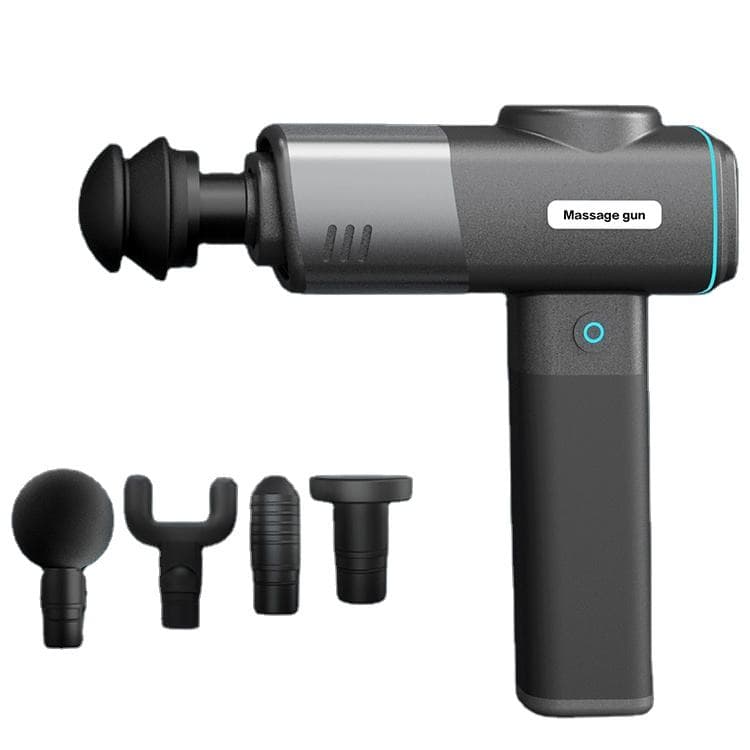
- Which attachments are included and what each is for — three to seven heads is typical, and relevance beats quantity
Frequently asked questions
What is a good amplitude for a massage gun?
There is no single right answer. Devices in the reviewed studies ranged from 10 mm to 16 mm. Deeper is not automatically better — testers found some devices too strong, with bruising possible.
Is higher PPM better?
No. Above roughly 30 strikes per second the device prepares muscle for activity; below that it encourages relaxation. Which you want depends on when you are using it.
What does stall force mean?
The pressure at which the head stops moving. Higher stall force lets you press into a tight area without the motor cutting out.
Why do two guns with the same PPM feel so different?
Because PPM is only frequency. Amplitude and stall force differ independently, and amplitude in particular is fixed in the hardware.
How many attachments do I actually need?
Most devices ship with a ball, flat head and cone, with three to seven in total. Relevance to your target muscles matters more than count.
Sources
- Sams L et al., Int J Sports Phys Ther (PMID 37020441) — 1 April 2023
- Stiftung Warentest — Massagepistolen im Test — 24 June 2024
- SRF Kassensturz — massage gun test — 8 October 2024
This article is general information, not medical advice. A therapeutic massager is intended to relieve minor muscle aches and pains; it does not diagnose, treat, cure or prevent any disease. Consult a qualified healthcare professional about your individual circumstances.